Contact
Open Hours
Vaccines
Destinations
BLOG
What we have to say about your health and well being
20
Nov 2025
Keep Antibiotics Working
Right click to edit the content...
How to keep antibiotics working
The discovery of antibiotics in the 1940s heralded a new age in modern medicine. This was quickly followed by the emergence and spread of drug-resistant bacteria, which we now know to be antimicrobial resistance (AMR).
Antimicrobials, including antibiotics, are used to prevent and treat infections in humans, animals, and plants. However, the more we use these medicines excessively or inappropriately, the more the microorganisms (bugs) they target evolve to survive and the antimicrobials stop working (AMR). Examples of misuse include taking antibiotics for viral infections, such as colds, sore throats, or coughs, which cannot be treated by antibiotics.
Guidance on antibiotics:
• Do not take antibiotics for colds and flu
• Do not save antibiotics for later
• Take antibiotics as directed by your healthcare professional
• Antibiotic resistance is a threat to your health.
• Antimicrobial resistance (AMR) happens when microbes evolve so that they can resist the medicine designed to kill them.
• Meaning in the future antibiotics might not work when you really need them.
• This puts you and your family at risk of a more severe or longer illness
• Inappropriate or excessive use of antibiotics increases the risk of bacteria becoming resistant to antibiotics.
• Antibiotics do not work for flu or colds, or for most coughs, sore throats or earache. Your body can usually fight these infections on its own.
• Antibiotic resistant bacteria don’t just affect you, they can spread to other people (and animals) in close contact with you and are very difficult to treat.
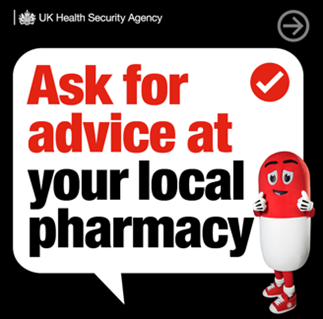
• Take your doctor, pharmacist or nurse’s advice when it comes to antibiotics.
• Antibiotics are important medicines and should only be taken when prescribed by a health professional.
• When antibiotics are prescribed by a health professional it is important that you always take them as directed. Never save them for later and never share them with others.
• Your medicine will have a label stuck to it reminding you how to take them.
• The use of inappropriate antibiotics may also allow other more harmful bacteria to increase.
• When you are prescribed antibiotics, if you have any left over, don’t throw them away or flush down the toilet. Take them to a pharmacy who can dispose of them correctly.
Useful Links
• UKHSA blog: What is Antimicrobial resistance and how can you combat it - UK Health Security Agency - https://ukhsa.blog.gov.uk/2025/04/07/what-is-antimicrobial-resistance-amr-and-how-can-you-combat-it/?utm_source=social&utm_medium=stakeholder&utm_campaign=Andibiotic&utm_id=AMR25
• UKHSA press release - Antibiotic resistant infections continue to rise - GOV.UK https://www.gov.uk/government/news/antibiotic-resistant-infections-continue-to-rise
• English surveillance programme for antimicrobial utilisation and resistance (ESPAUR) report - GOV.UK https://www.gov.uk/government/publications/english-surveillance-programme-antimicrobial-utilisation-and-resistance-espaur-report
Antimicrobials, including antibiotics, are used to prevent and treat infections in humans, animals, and plants. However, the more we use these medicines excessively or inappropriately, the more the microorganisms (bugs) they target evolve to survive and the antimicrobials stop working (AMR). Examples of misuse include taking antibiotics for viral infections, such as colds, sore throats, or coughs, which cannot be treated by antibiotics.
Guidance on antibiotics:
• Do not take antibiotics for colds and flu
• Do not save antibiotics for later
• Take antibiotics as directed by your healthcare professional
• Antibiotic resistance is a threat to your health.
• Antimicrobial resistance (AMR) happens when microbes evolve so that they can resist the medicine designed to kill them.
• Meaning in the future antibiotics might not work when you really need them.
• This puts you and your family at risk of a more severe or longer illness
• Inappropriate or excessive use of antibiotics increases the risk of bacteria becoming resistant to antibiotics.
• Antibiotics do not work for flu or colds, or for most coughs, sore throats or earache. Your body can usually fight these infections on its own.
• Antibiotic resistant bacteria don’t just affect you, they can spread to other people (and animals) in close contact with you and are very difficult to treat.
• Take your doctor, pharmacist or nurse’s advice when it comes to antibiotics.
• Antibiotics are important medicines and should only be taken when prescribed by a health professional.
• When antibiotics are prescribed by a health professional it is important that you always take them as directed. Never save them for later and never share them with others.
• Your medicine will have a label stuck to it reminding you how to take them.
• The use of inappropriate antibiotics may also allow other more harmful bacteria to increase.
• When you are prescribed antibiotics, if you have any left over, don’t throw them away or flush down the toilet. Take them to a pharmacy who can dispose of them correctly.
Useful Links
• UKHSA blog: What is Antimicrobial resistance and how can you combat it - UK Health Security Agency - https://ukhsa.blog.gov.uk/2025/04/07/what-is-antimicrobial-resistance-amr-and-how-can-you-combat-it/?utm_source=social&utm_medium=stakeholder&utm_campaign=Andibiotic&utm_id=AMR25
• UKHSA press release - Antibiotic resistant infections continue to rise - GOV.UK https://www.gov.uk/government/news/antibiotic-resistant-infections-continue-to-rise
• English surveillance programme for antimicrobial utilisation and resistance (ESPAUR) report - GOV.UK https://www.gov.uk/government/publications/english-surveillance-programme-antimicrobial-utilisation-and-resistance-espaur-report
CONTACT
1-2 Bingham Road
Sittingbourne
Kent
ME10 3SU
Sittingbourne
Kent
ME10 3SU
Contact Us
01795 512962
INFORMATION
Registered: England
Company registration : 05004312
Superintendent
Balbinder S. Dhariwal (2034114)
OPENING HOURS